

If you know zyi, you probably know us for brand identities, websites and campaigns. So it might seem a bit odd that we now want to look at how your invoices get sent.
Here's the honest reason. We kept seeing the same thing happen.
A client comes to us for a new brand. The work goes well. They launch, enquiries pick up, and then things start to wobble. Not the brand. The business behind it. Enquiries land in three different inboxes. Nobody is sure which version of the proposal went out. The founder is up at 11pm chasing an invoice from six weeks ago.
A strong brand brings more people to the door. If what's behind the door can't cope, the brand ends up making promises the business can't keep.
Design was always about systems
Good design is less about making things look nice and more about making good decisions repeatable. A brand system tells you which typeface, which colour and which tone of voice to use, so nobody has to reinvent it every time they make something.
Operations is the same idea pointed at a different problem: how work comes in, gets done, gets paid for and gets followed up.
When we build a brand, we ask what it needs to do, who will use it and where it might break. Those are exactly the right questions to ask about how a business runs. We've been asking them for years. We just hadn't been asking them about your back office.
Small gaps, big costs
We call them crevices. They're small gaps in how a business runs that don't look like much on their own:
A contact form that doesn't feed into anything, so someone copies it out by hand.
A task only one person knows how to do.
Two tools doing the same job, so nobody is sure which one is right.
A follow-up that only happens if someone remembers.
Each one costs a few minutes here and there. Together they can cost hours every week. They're also easy to miss, because everyone is too busy working around them to notice they're there.
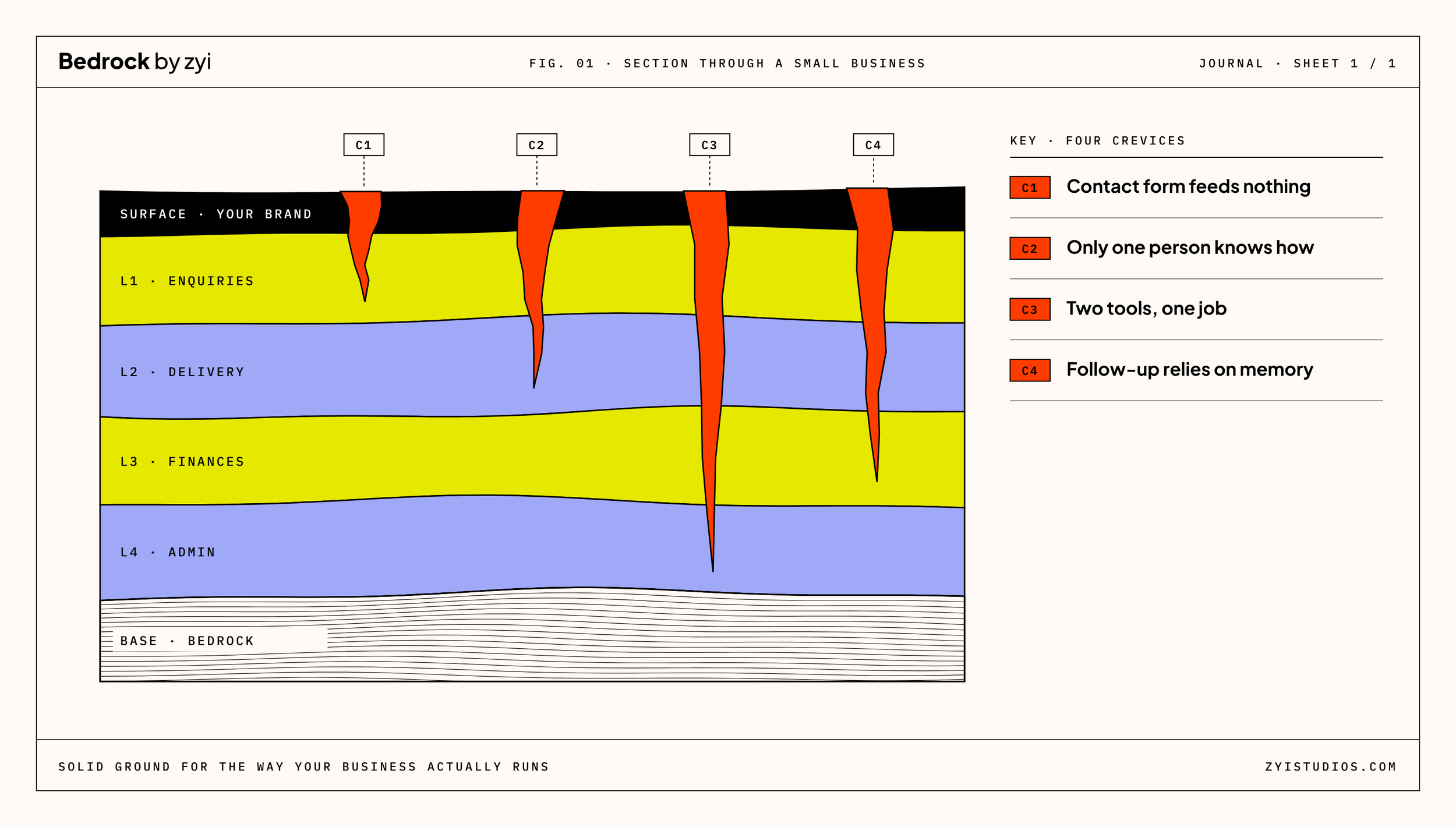
That's what Bedrock by zyi is for. It's our operations service. We find those gaps, put a real cost on them, and help you close them.
What Bedrock does
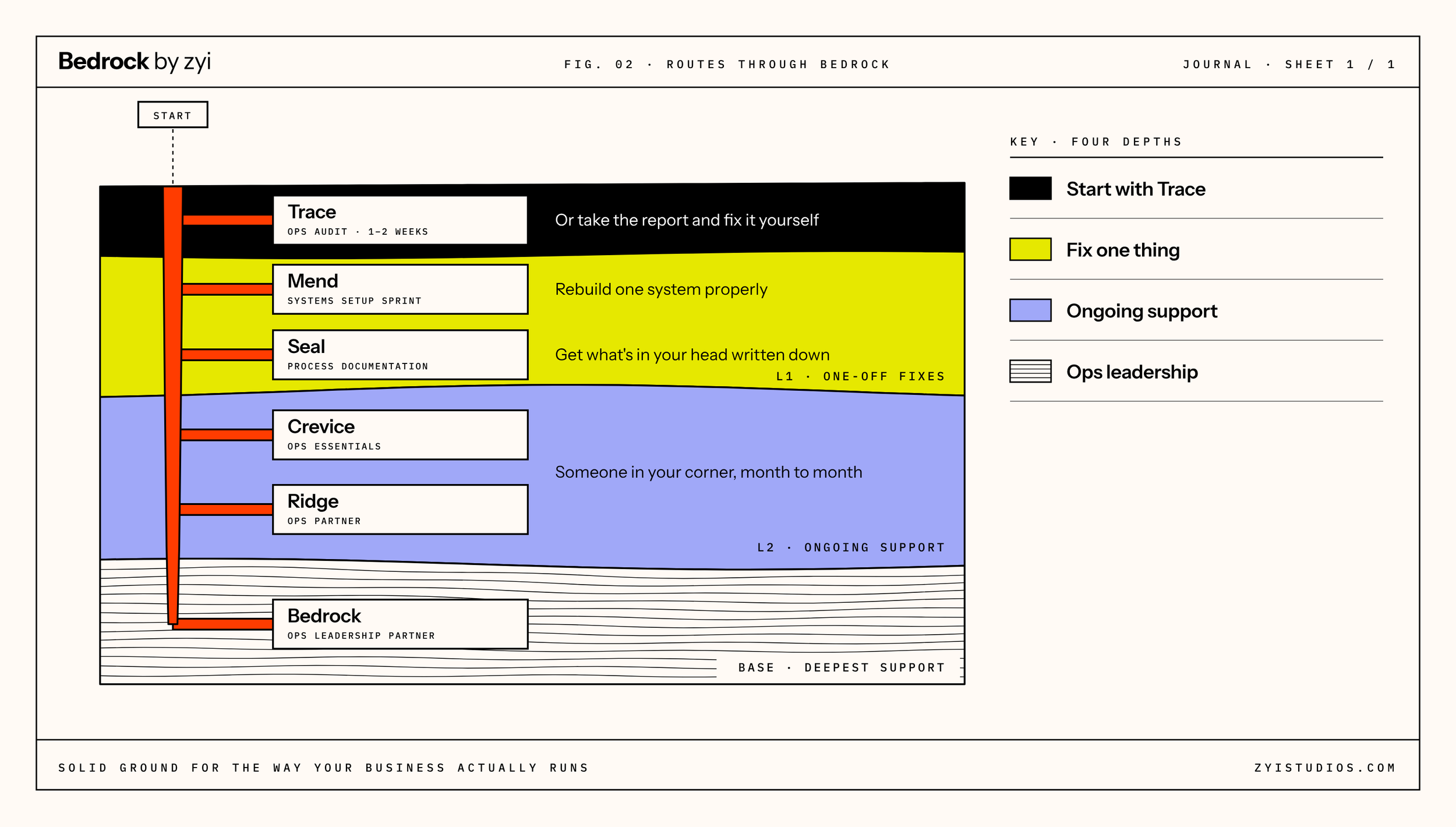
Everything starts with Trace (Ops Audit). It's a fixed-scope review of your processes, tools and bottlenecks, and it takes one to two weeks. At the end you get a findings report with the three to five gaps costing you the most, what each one costs in time or money, and the order to fix them in.
The report works on its own. Plenty of fixes are things you can do yourself, and we'll tell you which ones.
If you'd like help with the rest, there are a few routes:
Mend (Systems Setup Sprint) to rebuild one system properly.
Seal (Process Documentation Package) to get what's in your head written down, so the business doesn't depend on you remembering it.
Ongoing support through Crevice (Ops Essentials), Ridge (Ops Partner) or Bedrock (Ops Leadership Partner), if you'd rather have someone in your corner month to month.
Why a studio, not an ops firm
There are plenty of operations consultants out there. Here's what we think we do differently.
We design for the people using it. A system nobody enjoys using is a system nobody uses. We think about how a process feels to the person doing it at 5pm on a Friday, not just how it looks on a diagram.
We know small teams. Most of the businesses we work with are founder-led, creative or service-based, with a handful of people. We won't hand you an enterprise setup you can't maintain.
We make things you'll actually read. Our reports are designed the way we design everything else. The findings are on the first page, the costs are clear, and nothing is buried in jargon.
Same studio, solid ground
Bedrock is delivered by zyi. Same people, same care, pointed at a different part of your business.
Our aim is simple: solid ground for the way your business actually runs. Not the way it's supposed to run on paper. The way it really works, day to day, with the tools and people you already have.
If some of this sounds familiar, let's talk. A Trace (Ops Audit) is the easiest place to start.
