

"Ops audit" can sound like you're about to be marked. You're not. It's closer to a health check: someone with fresh eyes walks through how your business runs and tells you where it's leaking time and money.
Here's exactly what happens when you book Trace (Ops Audit) with Bedrock by zyi, so you know what you're signing up for.
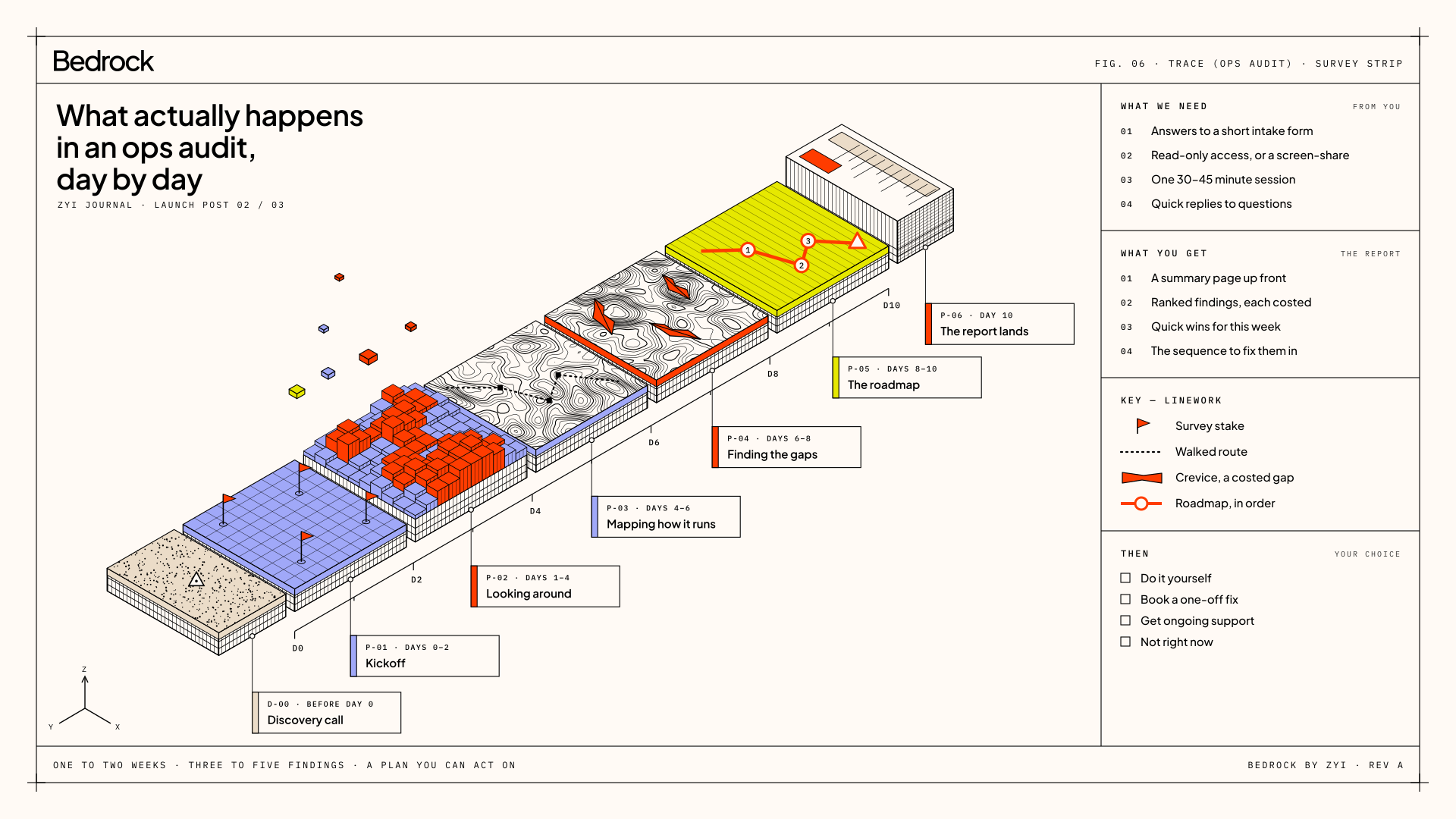
Before we start: the discovery call
We start with a short call. You tell us what's frustrating you, in your own words. It might be "admin is eating my week" or "we keep dropping enquiries" or just "something isn't working and I can't tell what." All of those are fine starting points.
If an audit is the right fit, we agree the scope and you book in.
Days 0–2: Kickoff
Within two working days of booking, we send a kickoff message that:
Confirms the scope and the pain points we talked about.
Sets an exact delivery date for your report.
Asks for access to the tools you use day to day, such as your project tool, invoicing tool and booking system. Read-only access is all we need.
Sends you a short intake form.
The intake form covers four things: every tool you use, who's on your team and what they do, your top three pain points, and the moments in your week when things get busiest. Most people finish it in one sitting.
If you'd rather not share access to your tools, that's fine. We'll do a screen-share walkthrough instead.
Days 1–4: Looking around
This is where we get to know how your business really works. We read your intake answers and look around your tools.
Then we run one session with you, about 30–45 minutes. Together we follow a piece of work all the way through: from the first enquiry, to doing the work, to sending the invoice, to following up. At each step we ask two questions: "what happens when…?" and "what breaks when…?"
You'd be surprised how often the answers are "I just remember" or "it depends who's in." Those answers are useful. They're where the gaps hide.
Days 4–6: Mapping how it actually runs
Next we map each part of your business as it runs today. Not how it's meant to run, and not how it would run in an ideal world. How it actually runs.
We usually cover four areas: client work, finances, admin and delivery. The maps are simple boxes and arrows. Their job is to make the gaps visible, not to look impressive.
Days 6–8: Finding the gaps
With the maps in front of us, we look for four kinds of gap:
Manual steps that could be automated or cut.
Single points of failure, where only one person knows how something works.
Tools doing the same job, so information lives in two places and nobody trusts either.
Things tracked in someone's head instead of in a system.
We then put a cost on each one, in hours a week or pounds where we can estimate it, and we show how we worked it out. Then we cut the list down to the three to five that matter most.
That short list is on purpose. A report with 40 problems in it is a report nobody acts on.
Days 8–10: The roadmap
For each gap, we write down what to fix, how to fix it and what order to do it in. The order follows what depends on what: if fixing your enquiry process makes fixing your invoicing easier, enquiries go first.
We also note which Bedrock package could deliver each fix. But the roadmap is written so you can follow it yourself if you'd prefer. It should still be useful even if you never work with us again.
The report lands
We send your findings report before any follow-up call, so you can read it in your own time without us in the room. Here's what's in it:
A summary page up front with the key numbers and findings, so you get the main points in two minutes.
Each finding ranked, with what's happening, what it costs and the fix.
Quick wins: free things you can do this week without anyone's help.
The sequence: a simple timeline showing what to fix first and what can happen at the same time.
Optional: the walkthrough
If you'd like, we'll go through the report together on a 30–45 minute call. You ask questions, we talk through the options, and you leave knowing what you want to do next.
Then: choosing your path
There's no hard sell at the end. You've got four options:
Do it yourself using the roadmap.
Book a one-off fix, like Mend (Systems Setup Sprint) or Seal (Process Documentation Package).
Get ongoing support through Crevice (Ops Essentials), Ridge (Ops Partner) or Bedrock (Ops Leadership Partner).
Not right now. That's fine too. We'll check in again in four to six weeks.
What we need from you
Answers to the intake form.
Read-only access to your tools, or a screen-share.
One 30–45 minute session.
Reasonably quick replies if we have a question.
If access or answers take longer than planned, we'll tell you the new delivery date rather than rush the report. The clock runs on having what we need, not on the calendar.
What it isn't
An audit isn't a judgement on how you've run things. Every business builds its processes in a hurry, around whatever was urgent at the time. That's normal.
It also isn't legal, tax or compliance advice. If we spot something in those areas, we'll flag it in the report and suggest you speak to a specialist.
Ready to start?
If you'd like a clear picture of where your business is losing time, Trace (Ops Audit) is the place to start. One to two weeks, three to five clear findings, and a plan you can act on.
